Cognitive Load Theory
Learning to read is a very complex process. As young children begin to learn letter names and sounds, they actually repurpose a part of the brain to store sound-symbol correspondences and eventually words. This process is highly demanding of a child’s young brain, and overstimulation can hinder a child’s growth. Neurodivergent students, already more susceptible to overstimulation due to differences in their nervous system, are especially at risk.
Cognitive load theory is based on the idea that the human brain takes in more stimuli compared to the processing ability of the working memory. Designing instruction that lowers cognitive load can help lower the risk of overstimulation and help students better access instruction. Cognitive load theory was first developed in the 1980s in an effort to ensure learning activities and materials were designed with a learner's limited resources for working memory in mind. By intentionally optimizing the choice and design of materials for instruction, teachers can lessen or even eliminate unnecessary cognitive load.
Guiding Principles of Cognitive Load Theory
Cognitive load theory includes five guiding principles. These guiding principles help designers determine the best tools and technologies for use in instructional development.
Multimedia
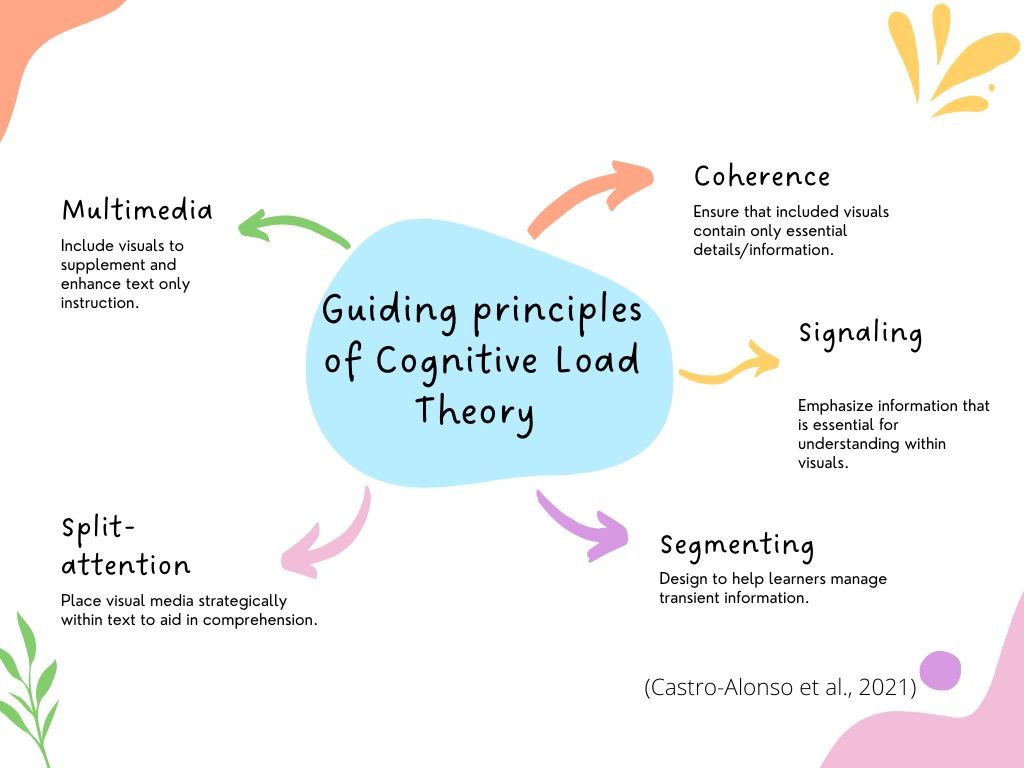
Many learners, especially neurodivergent learners, process visual information most easily. Using visuals, such as images, graphic organizers, tables, and charts, along with text engages multiple pathways in the brain and fosters better understanding and recall of the content. The inclusion of the visual below is an example of the principle of multimedia.
Coherence
When considering what type of visuals to use with instruction, teachers should consider the principle of coherence. Coherence is considering how parts relate to a whole. To keep visuals coherent, use only the essential information. This helps learners better identify and connect the intended focus. In the visual below, only the most important information is included. This is done with a one-sentence summary describing each principle. The arrows pointing outward help illustrate how each of the principles listed around the center is part of the whole.
Signaling
Signaling alerts learners to the most important information. When presenting information in a visual form, signals draw attention to the essential information necessary to integrate information from the visual with the text. This is especially important for neurodivergent learners, whose executive function differences can make focus more difficult. In the visual above, signaling is achieved with color coding. Colored headings used within the text correspond to the colored arrows shown in the visual.
Segmenting
The principle of segmenting calls for breaking down information into more digestible pieces. As the student gains mastery with each piece, the instruction continues into more complex applications. If you are familiar with the principle of systematic instruction, segmenting is a similar concept. Instructional activities and resources are intentionally designed to support the student, bit by bit, until the complete objective is reached. This design prevents working memory overload and helps the learner process the information more deeply and effectively.
Split-attention
When visuals accompany texts, learners must split their attention between the two. This creates extra cognitive load and can cause frustration and difficulty as learners work to integrate the information found in both sources. The principle of split-attention helps reduce this cognitive load by including easily identifiable details within the visual. For example, labels on a diagram, or key words from a legend placed directly onto the visual dramatically lower the cognitive load for the student. The diagram above illustrates the principle of split-attention. For each of the principles shown on the diagram, a summary sentence describing the principle is included.
Grounding instructional design in the framework of cognitive load theory supports the needs of not just neurodivergent students, but all learners. Just as teachers ensure that students are not overwhelmed by manipulatives and learning aids within the classroom, cognitive load theory ensures that neurodivergent learners are not overwhelmed by the materials or activities in a lesson. This intentional design ensures that instruction remains accessible to all learners in the classroom.
References
Castro-Alonso, J. C., de Koning, B. B., Fiorella, L., & Paas, F. (2021). Five strategies for optimizing instructional materials: Instructor- and learner-managed cognitive load. Educational Psychology Review, 33(4), 1379–1407. https://doi.org/10.1007/s10648-021-09606-9 Dehaene, S. (2021). How we learn: Why brains learn better than any machine ... for now. Penguin Books. Kanokpermpoon, M. (2019). English reading-listening materials and learners' information retention: An analysis of cognitive load theory. Newcastle University School of Education, Communication and Language Sciences. Moats, L. C., & Tolman, C. A. (2019). Letrs: Language essentials for teachers of reading and spelling. Sopris West Educational Services. Skulmowski, A., & Xu, K. M. (2021). Understanding cognitive load in digital and online learning: A new perspective on extraneous cognitive load. Educational Psychology Review, 34(1), 171–196. https://doi.org/10.1007/s10648-021-09624-7