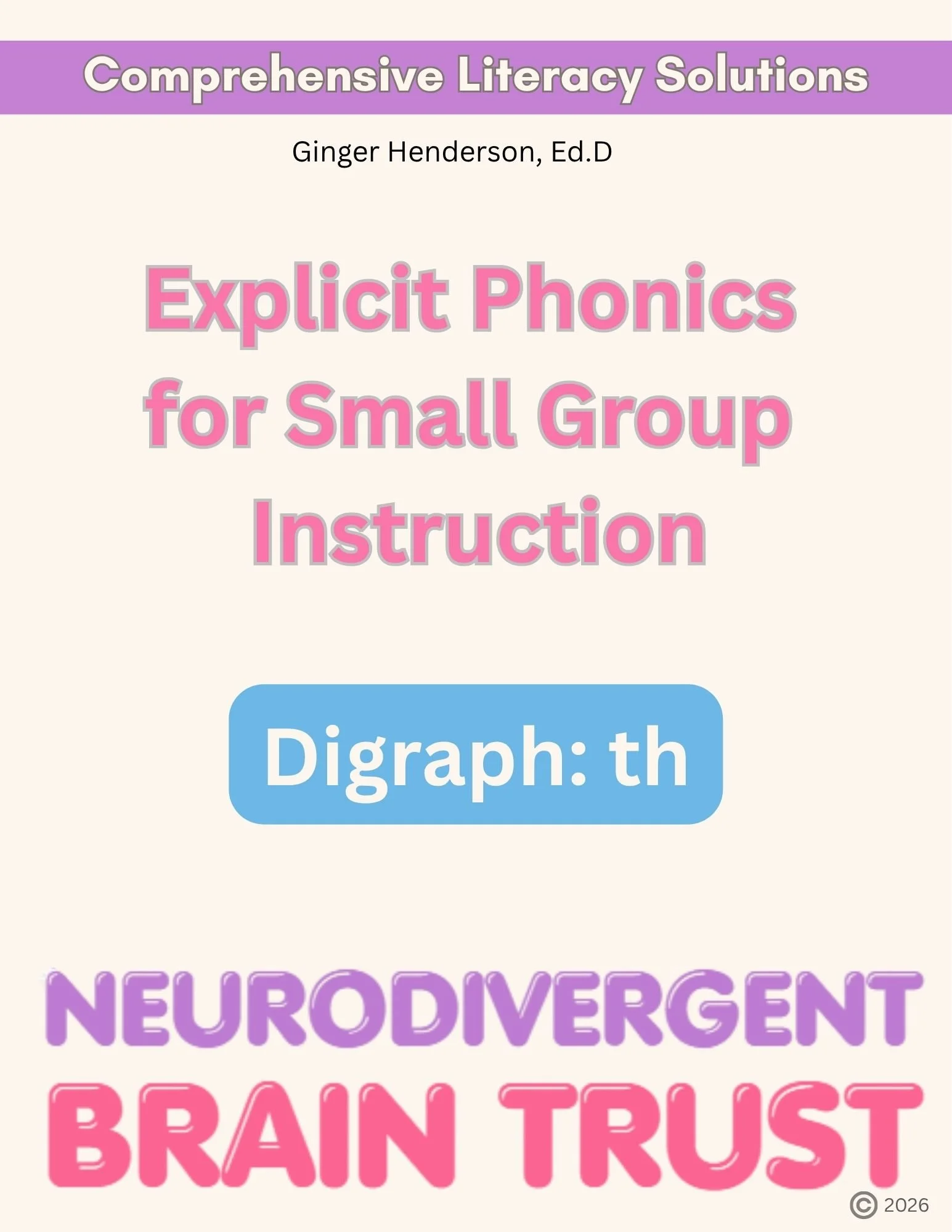
The NDBT Back to School Series: Differentiated Explicit Phonics Plans
The first set of explicit phonics lesson plans is now available in the ND Brain Trust library. These plans are evidence-based, zero-cost, ready to use, and designed with the kind of intentionality necessary to make learning accessible to a range of learners.
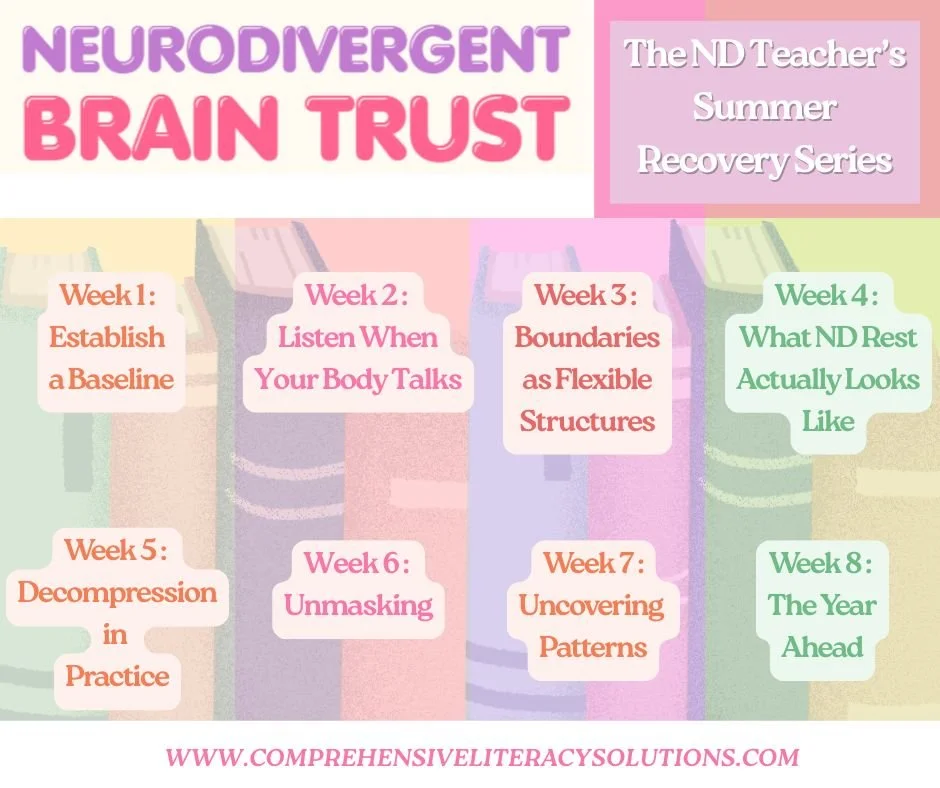
The NDBT’s Back to School Series
I’ve just finished publishing the complete summer series as a bundled download. Whether you worked through the series week by week this summer or you're just finding it now, the full bundle gives you everything you need to carry this work into the year ahead. It’s available in all three formats (pastel, neutral, and a special trimmed down grayscale print-friendly version) and like everything published in the NDBT, it’s available at no cost. This isn’t about profit. It’s about support.
The Year Ahead: Week 8 of the ND Teacher's Summer Recovery Series
There is a term in the research literature for what this week is about.
Biographical illumination is the experience of self-concept transformation in which understanding your neurology stops being just an explanation for your struggles and becomes something that transforms how you see yourself and how you move through your world.
That is where Week 8 is headed. And it is where eight weeks of honest, self-directed work can bring you when the framework is built around the person rather than the diagnosis.
Uncovering Patterns: Week 7 of the ND Teacher's Summer Recovery Series
Week 7 is the payoff week. The content pages walk through the full qualitative coding process — what it is, how it works in three stages, and the four specific categories to look for in your entries: meltdown precursor patterns, energy leak patterns, masking cost patterns, and restoration patterns.
The journal pages include a structured coding guide for your own material. You'll start with your Week 1 and Week 6 entries to see the range from where you began to where you are now, and then you’ll fill in the remaining weeks as your capacity allows.
Unmasking: Week 6 of the ND Teacher's Summer Recovery Series
Week 6 of the ND Teacher's Summer Recovery Series arrives at the most personal territory in the series — the question of who you actually are underneath the translation.
"Just be yourself" is good advice for people who know who that self is. For many neurodivergent people who have spent years masking by translating themselves into acceptable forms for NT spaces, the self that was supposed to show up got tucked away so gradually and so quietly that it became invisible.
This week names that process, traces its development across time, and begins the work of reversing it.
Decompression in Practice: Week 5 of the ND Teacher's Summer Recovery Series
Week 5 marks the turn in this series from understanding into building. The last four weeks gave you something most wellness content never offers: genuine self-knowledge grounded in your own data. This week you use it.
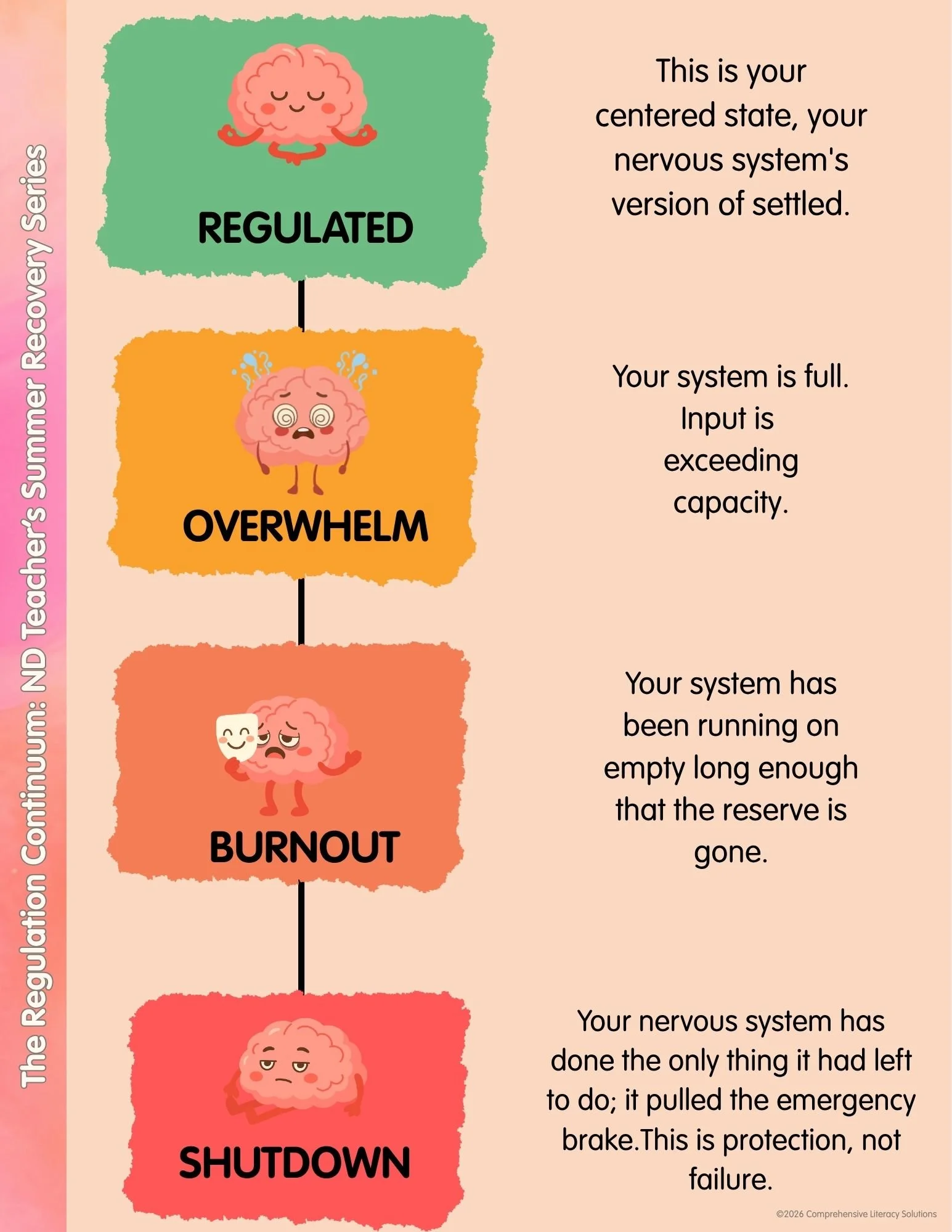
The content pages this week cover two important pieces before the build begins. The first is skill regression, not the dramatic clinical presentation, but the subtle, flexible, everyday version that most ND adults have been misreading as personal failure for years. The second is the ND Burnout Loop. This cycle explains how overwhelm becomes burnout becomes shutdown, and more importantly, how understanding the loop gives you a specific, effective point of intervention.
Both of these are evidence-informed frameworks drawn from the Ali et al. 2025 systematic review of 48 studies on ND burnout recovery. This isn't anecdotal wellness advice. This is what the research says.
What ND Rest Actually Looks Like: Week 4 of the ND Teacher's Summer Recovery Series
A 2025 systematic review of 48 studies on autistic burnout recovery identified the specific protective factors that actually support ND nervous system restoration. Rest, solitude, and sensory respite made the list. So did engaging with special interests. The bath bomb did not.
Week 4 of the ND Teacher's Summer Recovery Series gets specific about what evidence-based rest actually looks like for neurodivergent nervous systems and why the self-care industrial complex has been selling you solutions designed for someone else's biology.
Boundaries Aren't Walls: Week 3 of the ND Teacher's Summer Recovery Series
Week 3 of the ND Teacher's Summer Recovery Series reframes boundaries entirely, not as walls but as flexible structures that move with your nervous system's capacity. Drawing on the first law of thermodynamics and the emerging research on ND burnout recovery, this week introduces energetic boundaries: the practice of managing how your finite nervous system energy transfers rather than trying to maintain a rigid line that your nervous system will eventually override anyway.
Your position on the Regulation Continuum — which you've been tracking since Week 1 — directly determines your available energy threshold. A boundary that holds on a regulated Tuesday may not hold on a Thursday in overwhelm. That's not a failure of willpower. That's an energetic depletion.
The ND Teacher’s Summer Recovery Series: Welcome to Week 2 - Listen When Your Body Talks
Gratitude journaling assumes your emotions are easily discernable and nameable. For many neurodivergent brains that assumption simply isn't true. This is not because something is wrong with you, but because your nervous system processes emotional information differently.
Week 2 of the ND Teacher's Summer Recovery Series introduces two ways many neurodivergent people experience emotional awareness, alexithymia and hyperempathy. Many ND people experience one, the other, or both depending on the day, the environment, and how stimulated their nervous system already is.
Neither is a diagnosis. Neither is a flaw. Both are a result of the nervous system’s reaction to the enviornment.
The ND Teacher’s Summer Recovery Series: Welcome to Week 1 - Establishing a Baseline
You made it to summer. And if you're a neurodivergent educator, you already know that "made it" is doing a lot of work in that sentence. Making it doesn't always mean arriving restored. Sometimes it just means arriving. Depleted, masked-out, and running on the last reserves of a nervous system that has been giving everything it has since August. This summer we're doing something different. We're starting by getting honest about where you actually are — not where you think you should be, and not where you were before the school year took what it took.
Week 1 of the ND Teacher's Summer Recovery Series is about establishing your baseline. And it starts with one question: where are you right now?
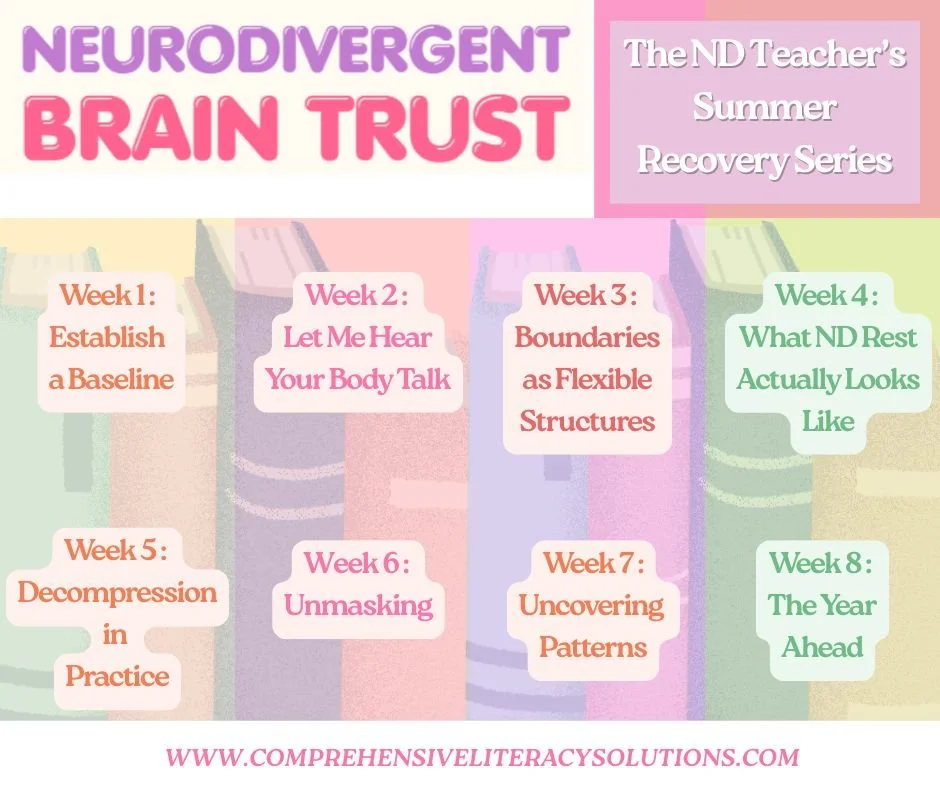
Everything You Need to Know Before We Begin: Your Guide to The ND Teacher's Summer Recovery Series
If you've been following along during this pre-launch, you're ready. If you're just finding this now — welcome. You haven't missed anything that can't be caught up in the next few minutes, and everything you need to get started is right here.
The ND Teacher's Summer Recovery Series begins in June. This post is your official orientation.
I built this series because I am an ND educator, and I spent too many summers trying to recover using tools that weren't designed for how my brain works. I know what it feels like to white-knuckle it to June and then spend July feeling guilty for not bouncing back faster.
I know what it feels like to need something that doesn't exist yet and decide to build it yourself.
This is me building it. For you, and honestly, for me too.

The ND Teacher’s Summer Recovery Series: A Beginner’s Guide to Qualitative Coding
Pattern recognition is frequently cited as a cognitive strength associated with autism, ADHD, and other ND profiles. You may have spent years feeling like your brain worked against you in systems that rewarded linear, sequential processing. Qualitative coding rewards a different kind of thinking entirely. It rewards noticing. It rewards the ability to hold multiple pieces of information at once and sense the connection between them.
You are not behind on this skill. You are very likely already ahead.
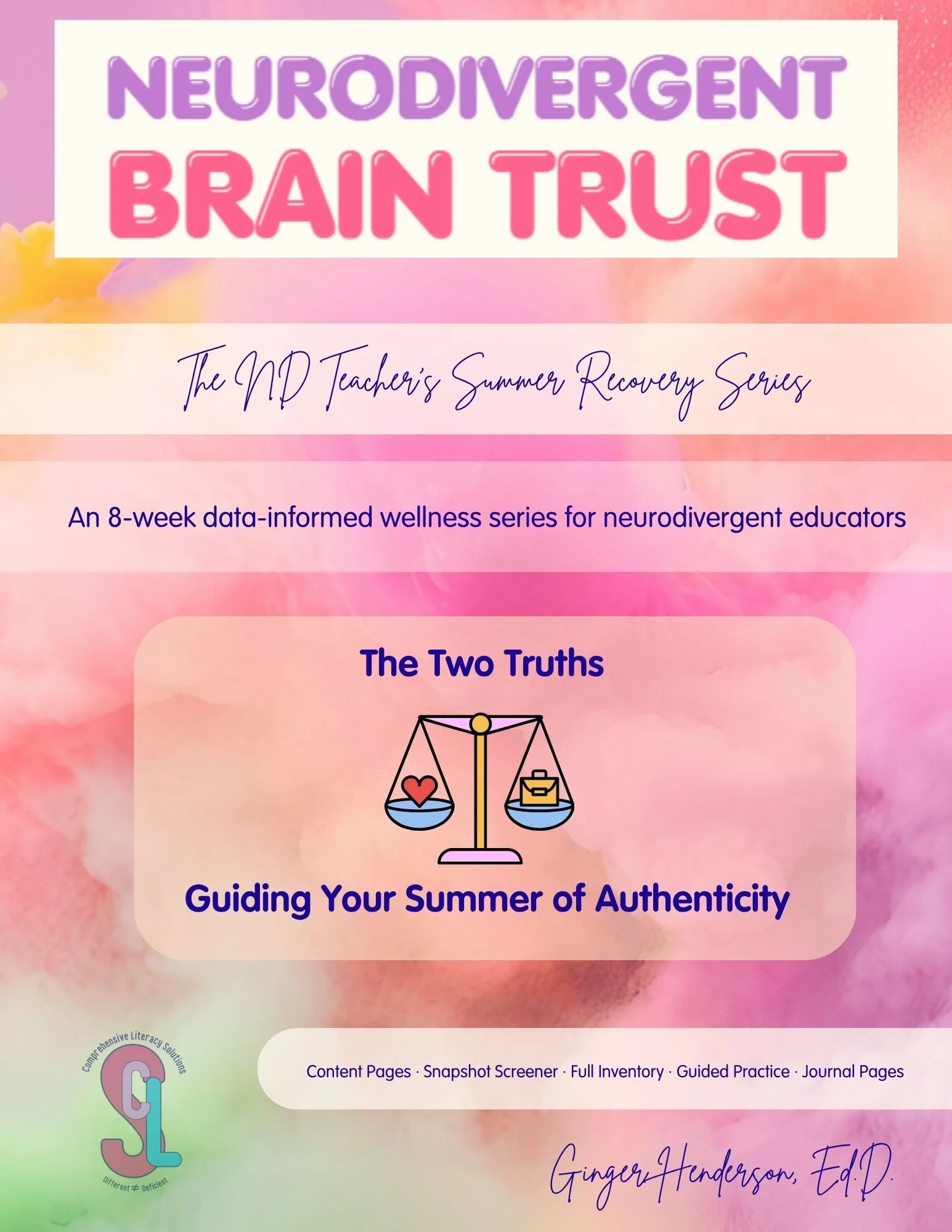
The Summer of Authenticity: Two Truths that will Guide your Summer Recovery
Numbers can tell you something is wrong before you can find the words to explain it.
You've probably experienced this. You rate your energy a 3 out of 10 for the fifth day in a row and you know something is wrong. But the number doesn't tell you what it means. It doesn't tell you what it felt like to sit in that faculty meeting and disappear behind your own eyes. It doesn't tell you about walking inside from your drive home and realizing you couldn't remember any of it. It doesn’t explain the way your chest still feels tight even now that school is almost over.
The number tells you something is true. It takes a different kind of data to tell you what that truth actually means.
This summer, we're working with both.
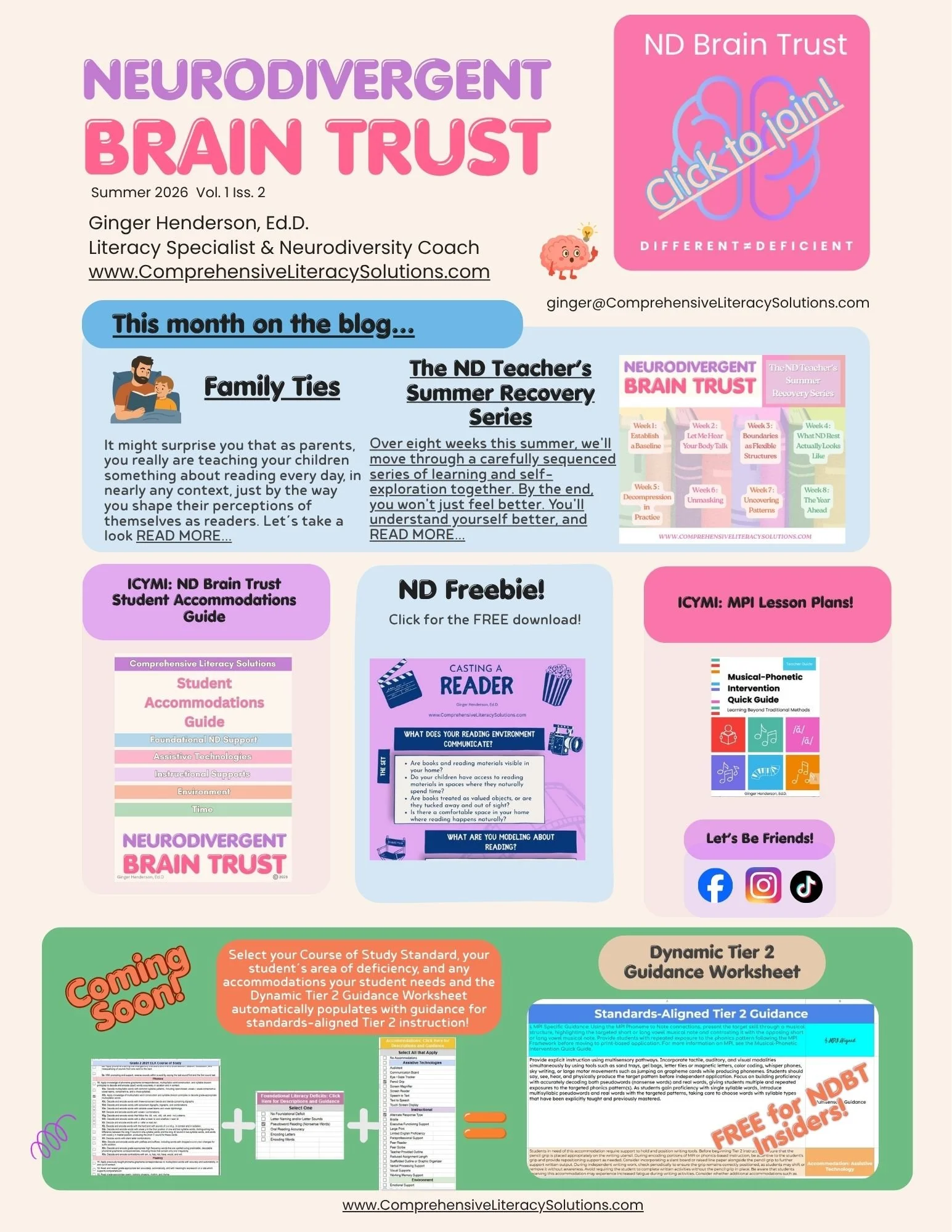
ND Brain Trust Quarterly: Vol. 1 Issue 2
ICYMI: The Summer 2026 edition of the ND Brain Trust Newsletter is live and in your inbox now! This issue includes the ND Teacher’s Summer Recovery Series info, Family Ties blog post, the Casting a Reader free download, a sneak peek at the Dynamic Tier 2 Guidance Worksheet, and ICYMI links to the Student Accommodations Guide and MPI Lesson Plans. Head to the newsletter archive or click below to check it out.
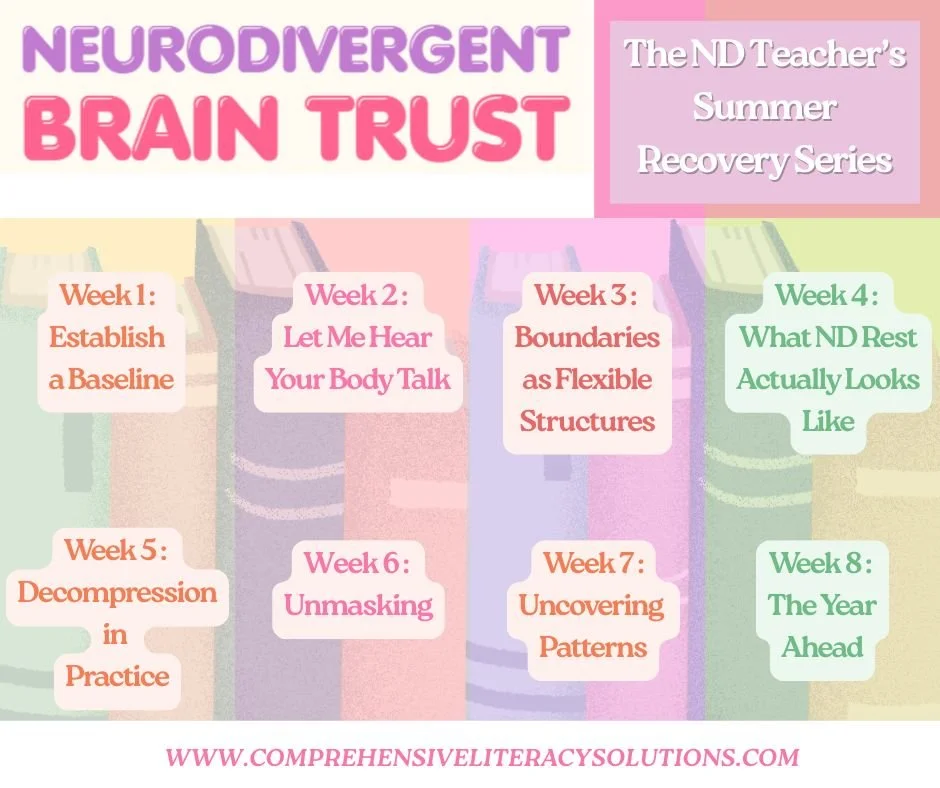
The ND Brain Trust Presents: The ND Teacher’s Summer Recovery Series
Why Most Wellness Content Doesn't Work for ND Brains
Here's the thing about generic teacher wellness advice: it assumes a generic teacher brain. Take a walk. Practice gratitude. Set boundaries. Get more sleep. These aren't bad suggestions, but for neurodivergent educators, they often land as one more thing you're doing wrong. You tried the morning routine and it lasted four days. You made the gratitude journal and felt nothing. You held the boundary and then spent three days in an anxiety spiral wondering if you handled it correctly.

Family Ties
I’m absolutely showing my age here, but if you grew up in the heyday of the 1980s, you’re no doubt familiar with the family sitcoms of the 1980s and 90s. Family Ties, Growing Pains, Diff’rent Strokes, Full House—- every episode tied up a neat little life lesson in 30 minutes or less. If only teaching our children to read were as easy as that, right?
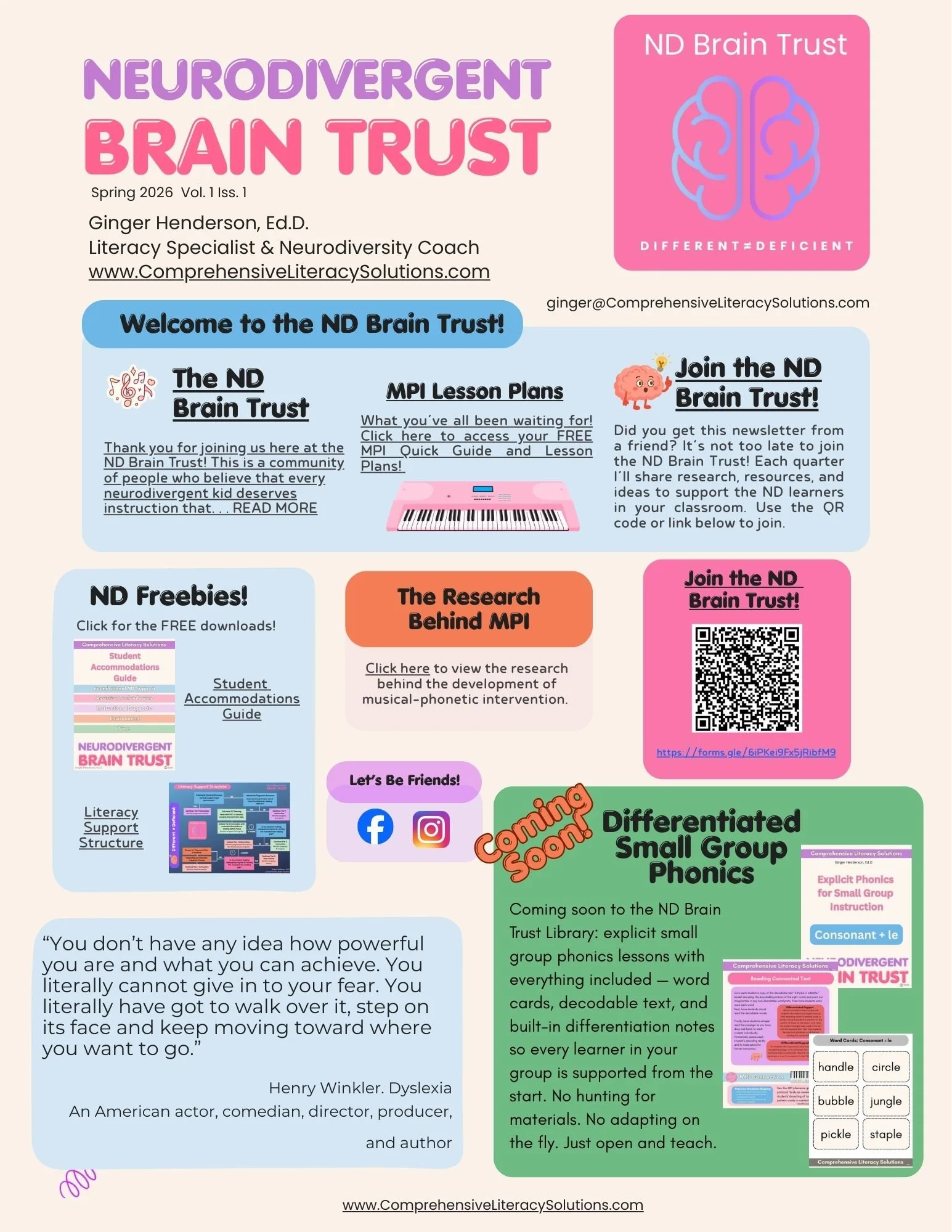
ND Brain Trust Quarterly: Volume 1 Issue 1
The very first edition of the NDBT Quarterly Newsletter dropped today, and I’m so excited to share it with all of you! In this issue you’ll find the long-awaited release of the complete Musical-Phonetic Intervention Quick Guide, the full MPI research, the brand new Student Accommodations Guide, and much more. Enjoy!
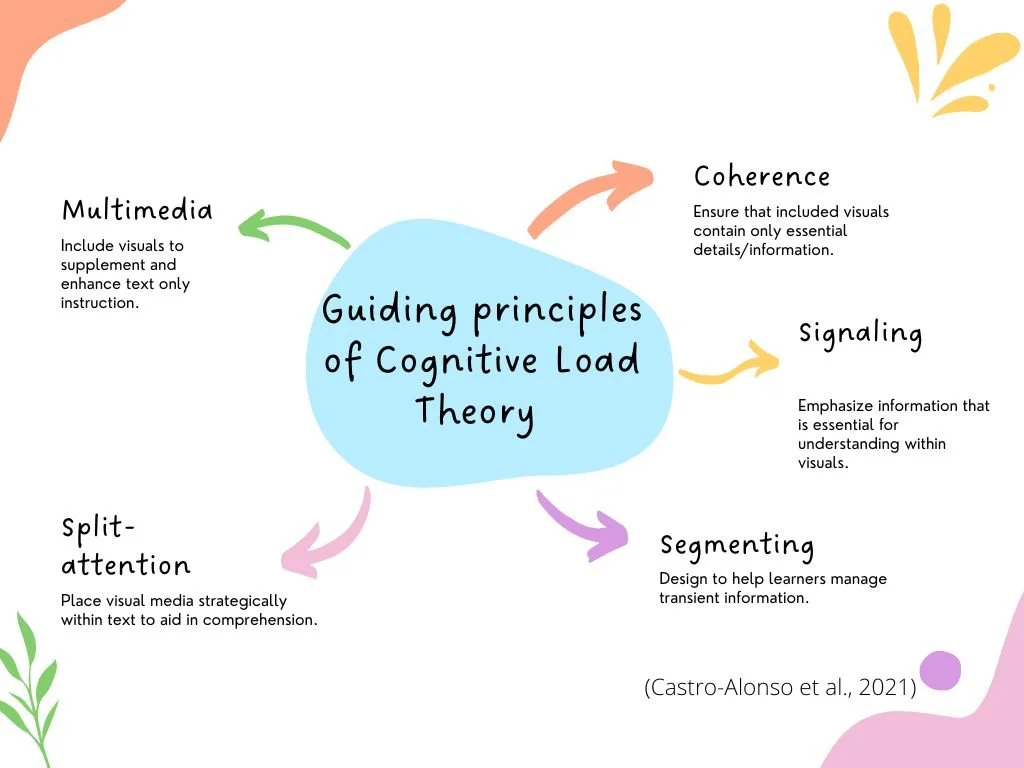
Cognitive Load Theory
Cognitive load theory is based on the idea that the human brain takes in more stimuli compared to the processing ability of the working memory. Designing instruction that lowers cognitive load can help lower the risk of overstimulation and help students better access instruction.
Welcome to the ND Brain Trust!
Thank you for joining us here at the ND Brain Trust! This is a community of people who believe that every neurodivergent kid deserves instruction that works with their brain, not against it.