The Summer of Authenticity: Two Truths that will Guide your Summer Recovery
The Two Kinds of Truth: How Quantitative and Qualitative Data Will Guide Your Summer
Numbers can tell you something is wrong before you can find the words to explain it.
You've probably experienced this. You rate your energy a 3 out of 10 for the fifth day in a row and you know something is wrong. But the number doesn't tell you what it means. It doesn't tell you what it felt like to sit in that staff meeting and disappear behind your own eyes. It doesn't tell you about walking inside from your drive home and realizing you couldn't remember any of it. It doesn’t explain the way your chest still feels tight even now that school is almost over.
The number tells you something is true. It takes a different kind of data to tell you what that truth actually means.
This summer, we're working with both.
What Quantitative Data Does Well
In the last post, I introduced the idea that you've been collecting data about yourself your whole life. As an ND individual you’ve also very likely spent a whole lot of time analyzing (and over-analyzing) that data, too. This summer, we’re going to make that process intentional. Quantitative data is where a lot of that intentionality starts, because numbers give us something we can track across time.
When you rate your stress level at the beginning of the summer and again at the end, you have a comparison point. When you check in weekly on how regulated your nervous system feels, you start to see patterns in the data. Maybe you always dip in the third week of a break, or maybe you need a full two weeks before your numbers start to climb. That's information you can actually use.
Quantitative data in this series will show up as simple rating scales, frequency checks, and brief numerical snapshots. Nothing complicated. Nothing that feels like a survey. Just enough data to give your experience some shape over the summer.
What quantitative data can't do is explain itself. A 4 out of 10 on nervous system regulation doesn't tell you whether that 4 feels like exhaustion or anxiety or grief or relief. It doesn't tell you what's underneath it. For that, we need narrative.
What Qualitative Data Captures That Numbers Can't
Qualitative data is descriptive, contextual, and deeply personal. It's the story behind the number. It's the texture of an experience — what it looked like, felt like, sounded like inside your own head.
When you write freely about your day without filtering or editing yourself, you are generating qualitative data. When you describe what your body does when you're overwhelmed, or what you notice in the hour after you've finally decompressed, or what it feels like to exist in your own home without performing for anyone, that is rich, meaningful data about your nervous system, your needs, and your patterns.
Qualitative data takes longer to analyze. You can't average it or immediately graph it. But it holds information that a scale of 1 to 10 can’t match. It holds the why. And for neurodivergent brains that have spent years being misread — by systems, by colleagues, sometimes even by themselves — the why matters enormously.
Two Kinds of Truth, Both Authentic
If you've encountered Dialectical Behavior Therapy (DBT) concepts before, this might feel familiar. One of the core ideas in dialectical thinking is that two things can be true at the same time, even when they seem to contradict each other. You can be exhausted and grateful. You can love your students and be depleted by your job. You can know intellectually that you need rest and still feel guilty taking it. Authentic existence means wrestling with duality, and that is something that ND brains may particularly struggle with accommodating.
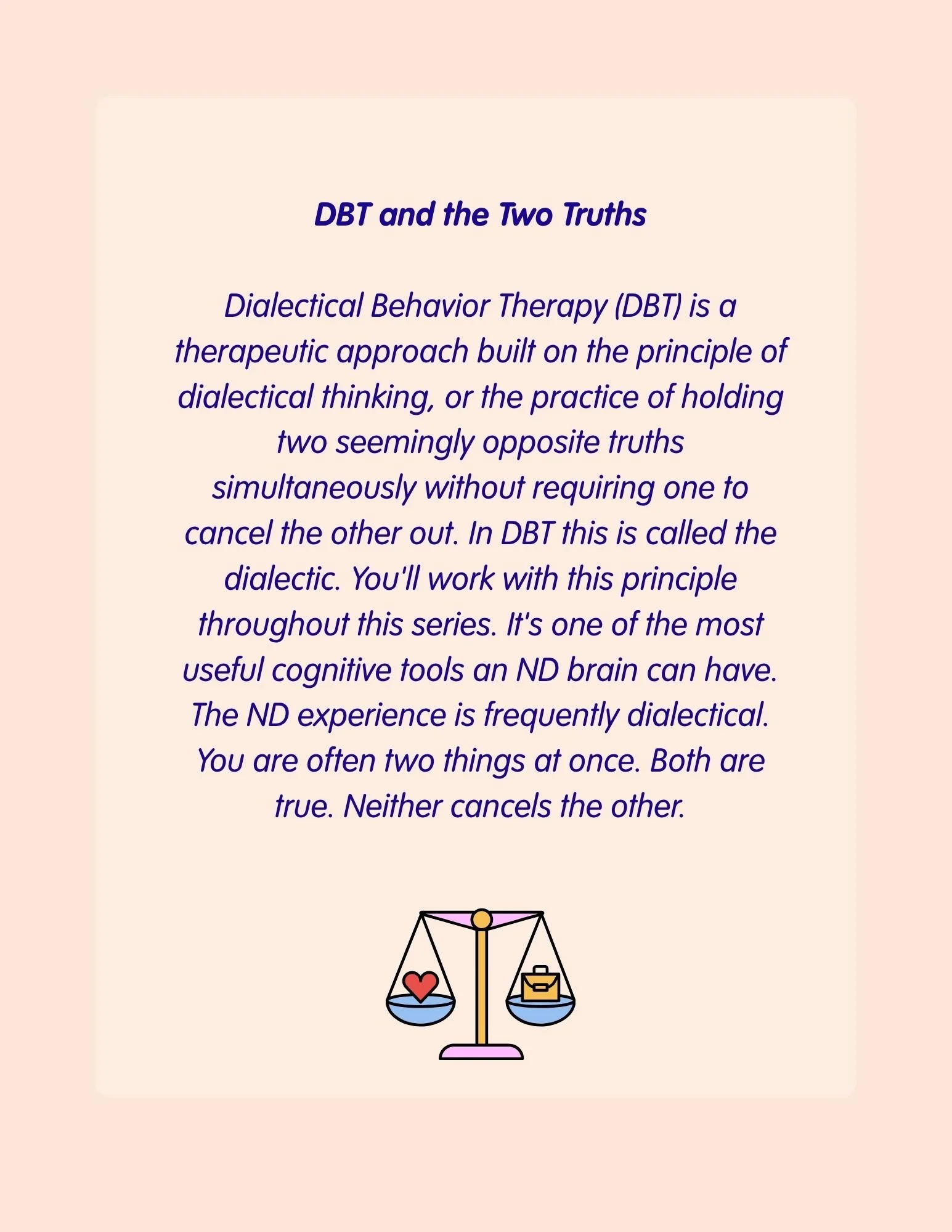
Dialectical Behavior Therapy (DBT) is a therapeutic approach built on the principle of dialectical thinking, or the practice of holding two seemingly opposite truths simultaneously without requiring one to cancel the other out. In DBT this is called the dialectic. You'll work with this principle throughout this series. It's one of the most useful cognitive tools an ND brain can have. The ND experience is frequently dialectical. You are often two things at once. Both are true. Neither cancels the other.
Quantitative and qualitative data work the same way. Neither one is the whole truth, and neither one cancels the other out. The number gives you one true thing. The narrative gives you another true thing. Together, they give you a fuller picture than either could provide alone.
This isn't just a research principle. It's a permission structure. You don't have to choose between the data that's easy to measure and the data that's hard to articulate. We're going to hold both.
You're Already Doing This
Here's something I want to explicitly point out. You do this in your classroom every day.
When a student scores a 42% on a phonics screener, you don't stop there. You observe them during instruction. You note what they do when they get stuck. You listen to understand the strategies they use.
You look for the pattern underneath the number.
You use quantitative data to identify the flag and qualitative data to understand what's actually happening.
You already know how to do this work. We're just redirecting the lens.
How We'll Use Each Type This Summer
Each week of the series will include both a quantitative check-in and a qualitative journal entry. The check-ins will be brief. They’ll consist of a few ratings or frequency markers that take less than five minutes. The journal entries will be open and exploratory, guided by prompts but never constrained by them.
At the end of the series, in Week 7, we'll bring it all together. I'll walk you through a simple, accessible version of qualitative coding — a process for reading back through your own writing and identifying the themes and patterns your nervous system has been signaling all summer. That's where the real self-discovery happens. That's where the data stops being abstract and starts being a mirror.
A Word About Free Journaling
If the word "journaling" makes you tense up a little, let’s address that.
Free journaling in this context doesn't mean “Dear Diary.” It doesn't mean writing beautiful sentences or processing deep trauma or filling three pages before breakfast. It means writing honestly and authentically, without editing yourself, about whatever the prompt opens up for you. Some entries will be two sentences. Some might go longer than you expected. Both are fine. The goal is not volume, it's honesty.
For ND brains in particular, unstructured writing can feel either incredibly freeing or incredibly activating, depending on the day and the topic. The prompts in this series are designed to give you enough structure to get started without constraining where you go. You are always allowed to take them in a direction I didn't anticipate. That's not going off script, that's exactly the kind of data we're looking for.
If you want to get a head start before the series begins, start now. Pick up a notebook or open a document and spend five minutes writing about how you're feeling as this school year comes to an end. Don't edit it. Don't make it make sense. Just let it be honest.
That entry might become your most interesting data point of the whole summer.
It’s almost time! I can’t wait to start this journey alongside you.
~Dr. Henderson