Family Ties
I’m absolutely showing my age here, but if you grew up in the heyday of the 1980s, you’re no doubt familiar with the family sitcoms of the 1980s and 90s. Family Ties, Growing Pains, Diff’rent Strokes, Full House—- every episode tied up a neat little life lesson in 30 minutes or less. If only teaching our children to read were as easy as that, right?
While the mechanics of learning to read are definitely no easy feat, it might surprise you that as parents, you really are teaching your children something about reading every day, in nearly any context, just by the way you shape their perceptions of themselves as readers. Let’s take a look into the “Family Ties” of reading and the ways we, as adults, influence the young readers in our lives.
Scene One: Meet the Cast
As children arrive at school, they bring their “character” along with them in the form of their self-concept. While a child’s self-concept is shaped by many factors and experiences, the vast majority of these occur within the home. It makes sense, right? This is where children spend most of their time, so it stands to reason that their experiences and interactions with the loved ones in their home have a large impact on the development of self-concept.
Before children learn to read a book, they become adept at reading a room.
They pick up on our perceptions of them, both positive and negative, both said and unsaid. These perceptions shape the way they view themselves as individuals and as learners. This is especially true for our neurodivergent thinkers. Their brains are always seeking out patterns, and these patterns shape their beliefs in their abilities.
Scene Two: The Script They’re Given
Parent attitudes have a powerful influence on a child’s reading outcomes. In a 2020 study that investigated parent-child contagion, researchers found that parents’ values in education strongly influenced how well their children did in school subjects. Among families who displayed positive emotions about reading, both sons and daughters showed increases in reading achievement; however, this achievement was larger among daughters. In families who displayed higher positive emotions about math and science domains, sons outperformed daughters. The researchers credit this to expectancy-value theory, a theory that a student’s choices when learning are a result of their expectations for success combined with their interest and self-concept. When children believe they will do well at a task, they are driven to choose that task. As they succeed at that task, their self-concept is affirmed, creating a positive feedback loop. As positive emotions become associated with tasks, reward centers in the brain receive a hit of dopamine, the brain chemical that provides pleasure. This creates a powerful brain hack that drives a child’s motivation to continue learning.
So why the difference in the development of reading versus math feedback loops in the genders? This is further explained in a 2021 study in which researchers found that perceptions of a mother’s judgment about a task predicted the child’s achievement. In this study, mothers of daughters impressed importance of reading tasks and scored daughters higher for reading skills, while mothers of sons praised math abilities and scored sons higher in mathematics tasks, even though the children were performing at very similar levels in both subjects.
Our perceptions as parents are powerful.
Scene Three: The Role Follows Them to School
These perceptions and stereotypical influences travel to school with children. It’s been long believed that teacher perceptions hold an influence over student achievement, but recent research has indicated that it is student perceptions of teacher expectations, rather than the expectations themselves, that drive changes in learning outcomes. Students who bring stereotypical beliefs about themselves communicated by their parents perceive that teacher expectations follow these same stereotypes. For males, this frequently means underperformance in reading. Remember the feedback loop? It begins with choice. If the child’s expectancy-value theory surrounding reading is low, the child is less likely to choose the task of reading, because they are more likely to get a positive feedback loop from another task. Reading slips further and further down the list, contributing to what’s commonly known as the “Matthew Effect,” where good readers become better and better through increased exposure to complex text while reluctant readers miss out on this additional exposure to literature.
Scene Four: Rewriting the Script
Unfortunately, it’s not as easy to tie real life up in 30 minutes like our favorite 80s sitcoms, so there’s no quick and easy “teachable moment” here. But the same research that reveals the problem also points toward something hopeful: the script can be rewritten, and parents hold the pen.
It starts with awareness. The mothers in the 2021 study weren't intentionally steering their sons away from reading. Instead, they were operating on perceptions so normalized they likely never even realized they existed. Before we can examine our own thinking, we first have to notice it. Scientists call that metacognition (thinking about your thinking) and it’s one of the most powerful strategies you can employ to bring changes in your awareness. Simply understanding our own perceptions and influence and knowing that our emotional signals about reading are contagious is the first, most powerful step.
From there, it becomes a practice of intentionality. What does your family's reading culture look like? Are books visible in your home? Do your children see the adults they love reading? Or do they just hear adults telling them to read while they choose other activities? For sons especially, do they see men who read? Do they hear adults talk about books, stories, or ideas with enthusiasm rather than obligation?
None of this requires a curriculum or a lesson plan. It requires presence and awareness — the willingness to examine the quiet, everyday messages we send about who readers are and who gets to be one.
The Curtain Call
Every family sitcom had a formula: a problem, a misstep, a lesson, a resolution. Neat. Predictable. Satisfying.
Real family life (and real literacy development) doesn't work that way. But the heart of those old episodes was true: families are where children first learn who they are. And when it comes to reading, that lesson starts long before they ever open a book.
The good news is that you don't need a script to be a positive force in your child's literacy story.
You just need to know that you already are one.
~Dr. Henderson
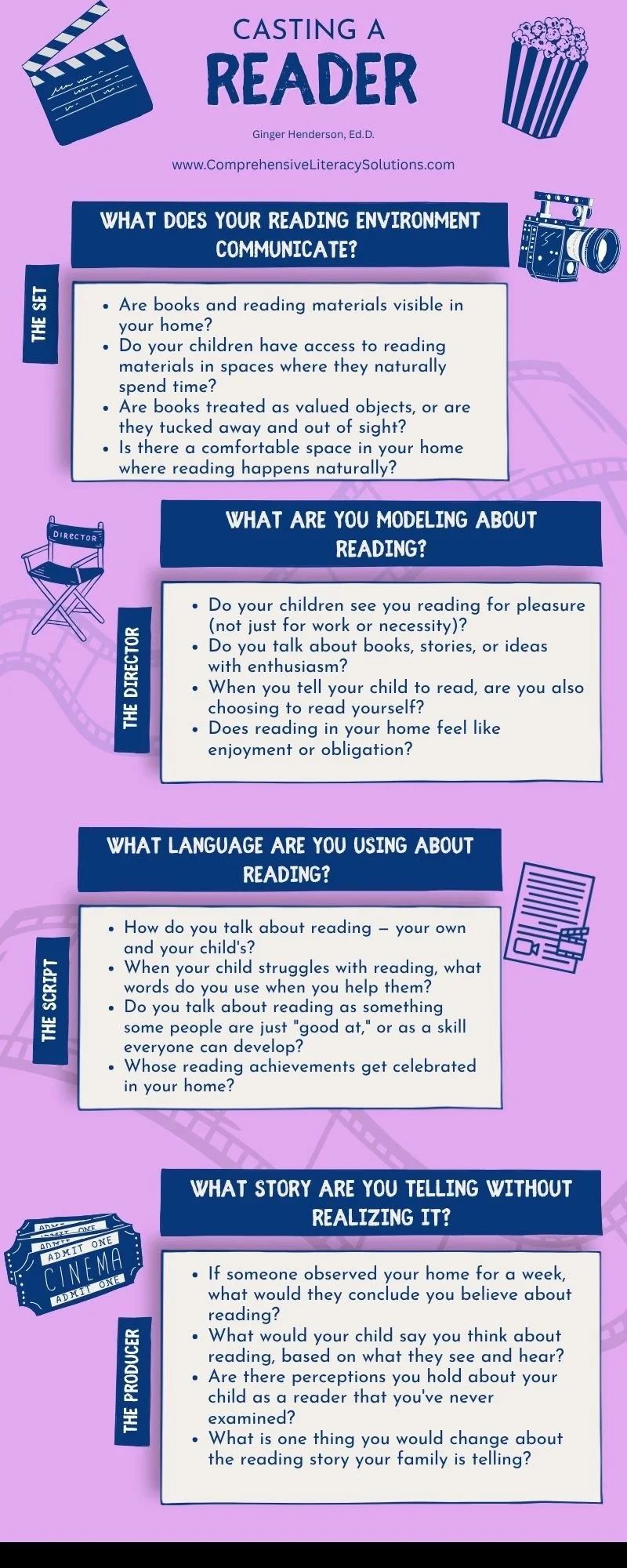
Casting a Reader. Comprehensive Literacy Solutions, 2026
References:
Espinoza, A. M., & Strasser, K. (2020). Is reading a feminine domain? The role of gender identity and stereotypes in reading motivation in Chile. Social Psychology of Education, 23(4), 861–890. https://doi.org/10.1007/s11218-020-09571-1
Nalipay, M. J. N., Cai, Y., & King, R. B. (2020). Why do girls do better in reading than boys? How parental emotional contagion explains gender differences in reading achievement. Psychology in the Schools, 57(2), 310–319. https://doi.org/10.1002/pits.22330
Nollet, M. (2021, June 14). The effect of teacher expectations on the gender gap in reading performance. https://studenttheses.uu.nl/handle/20.500.12932/40002
Parker, P. D., Sanders, T., Anders, J., Parker, R. B., & Duineveld, J. J. (2021). Maternal judgments of child numeracy and reading ability predict gains in academic achievement and interest. Child Development, 92(5), 2020–2034. https://doi.org/10.1111/cdev.13573