The ND Brain Trust Presents: The ND Teacher’s Summer Recovery Series
An Analytical Approach to Nervous System Recovery
Almost there.
As this message hits your feed, you are somewhere in that final stretch of the school year. The to-do list is still long but your tank is running on fumes. Maybe you're already mentally checked out and white-knuckling it to the last day. Maybe you've been in shutdown for weeks and nobody around you has noticed because your masking game is on point. Maybe you genuinely don't know how you feel, you just know that summer needs to get here soon.
These feelings and experiences are not symbols of weakness. They’re what happens when a neurodivergent brain spends nine months masking, regulating, accommodating, and selflessly giving in an environment that was not designed with a neurodivergent nervous system in mind.
I see you. I am you. And I built this series for you.
Why Most Wellness Content Doesn't Work for ND Brains
Here's the thing about generic teacher wellness advice: it assumes a generic teacher brain. Take a walk. Practice gratitude. Set boundaries. Get more sleep. These aren't bad suggestions, but for neurodivergent educators, they often land as one more thing you're doing wrong. You tried the morning routine, and it lasted four days. You made the gratitude journal and felt nothing. You held the boundary and then spent three days in an anxiety spiral wondering if you handled it correctly.
The problem isn't you. The problem is that most wellness frameworks weren't built for how your brain actually works.
This series takes a different approach. Instead of handing you a prescribed set of strategies and asking you to fit yourself into them, we're going to start with you — your patterns, your signals, your data — and build outward from there.
You Are a Rich Source of Data
I get it. "Data" might not be the word you were expecting in a wellness series. But hear me out.
You already think in data. You track student progress, analyze assessment results, and look for patterns in behavior. You do this instinctively because you understand that holding this information leads to better decisions and shapes more informed and attainable outcomes. This summer, we're going to turn that same lens on your own experience.
Because you deserve the same quality of attention you give your students.
Over the eight weeks in this series, you'll be collecting two kinds of information about yourself: numbers and narratives. Both matter. Neither tells the whole story alone.
A Quick and Painless Data Primer
You don't need a research background for any of this. Here's all you need to know right now:
Quantitative data is numerical. It measures things in amounts, frequencies, or ratings. When you rate your stress level on a scale of 1 to 10, that's quantitative data. When you track how many hours you slept or how many times this week you felt genuinely calm, those are numbers that tell you something.
Qualitative data is descriptive. It captures experience, meaning, and texture. When you write about what your body felt like after a hard day, or describe what it looked like when you finally felt rested, that's qualitative data. It tells you the story behind the numbers.
In this series, we'll use both. Weekly reflections will give you quantitative snapshots. These quick ratings and check-ins will let you see change over time. Your journal entries will give you the qualitative depth, the rich, personal narrative that numbers alone can't capture.
What to Expect This Summer
Over eight weeks this June and July, we'll move through a carefully sequenced series of learning and self-exploration together. By the end, you won't just feel better. You'll understand yourself better, and you'll have something concrete to carry into the new school year.
Each week will include a blog post with some food for reflection, journal pages for your data collection, and space on social media for our community to reflect together. In a couple of weeks I'll walk you through exactly how qualitative coding works and why free journaling is one of the most powerful self-discovery tools an ND brain can use. For now, just know that nothing about this process requires you to be a researcher. It only requires you to be honest with yourself.
Authenticity can set you free. I’ve got the guidebook to get us there.
Let’s travel on this authentic journey to rest and regulation together. In the next few weeks leading up to the launch, I’ll share more details here on the NDBT blog. Stay tuned and stay strong! I’ll see you again soon.
~Dr. Henderson
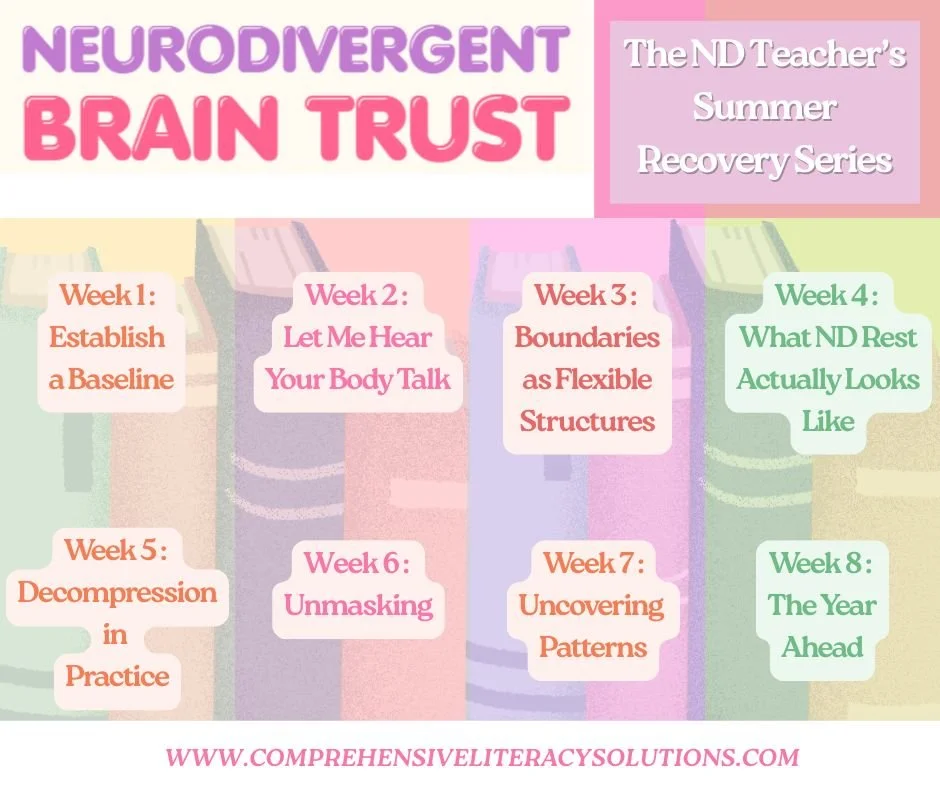
An image of an outline of the ND Teacher’s Summer Recovery Journal Series. Week 1: Establish a Baseline, Week 2: Let Me Hear Your Body Talk, Week 3: Boundaries as Flexible Structures; Week 4: What ND Rest Actually Looks Like; Week 5: Decompression in Practice; Week 6: Unmasking; Week 7: Uncovering Patterns; Week 8: The Year Ahead.