Decompression in Practice: Week 5 of the ND Teacher's Summer Recovery Series
You downloaded the habit tracker. You filled in the first few days. You felt genuinely optimistic.
Then one unexpected demand, one bad sensory day, one morning where executive function simply didn't show up, and the whole structure collapsed. You looked at the empty grid and felt worse than before you started.
Habit tracker culture has one explanation for this: You didn't try hard enough.
Here's the actual explanation: You were using a tool designed for a fixed-state nervous system on a dynamic, state-dependent one. The routine was built for a regulated day. Your nervous system doesn't have regulated days on demand.
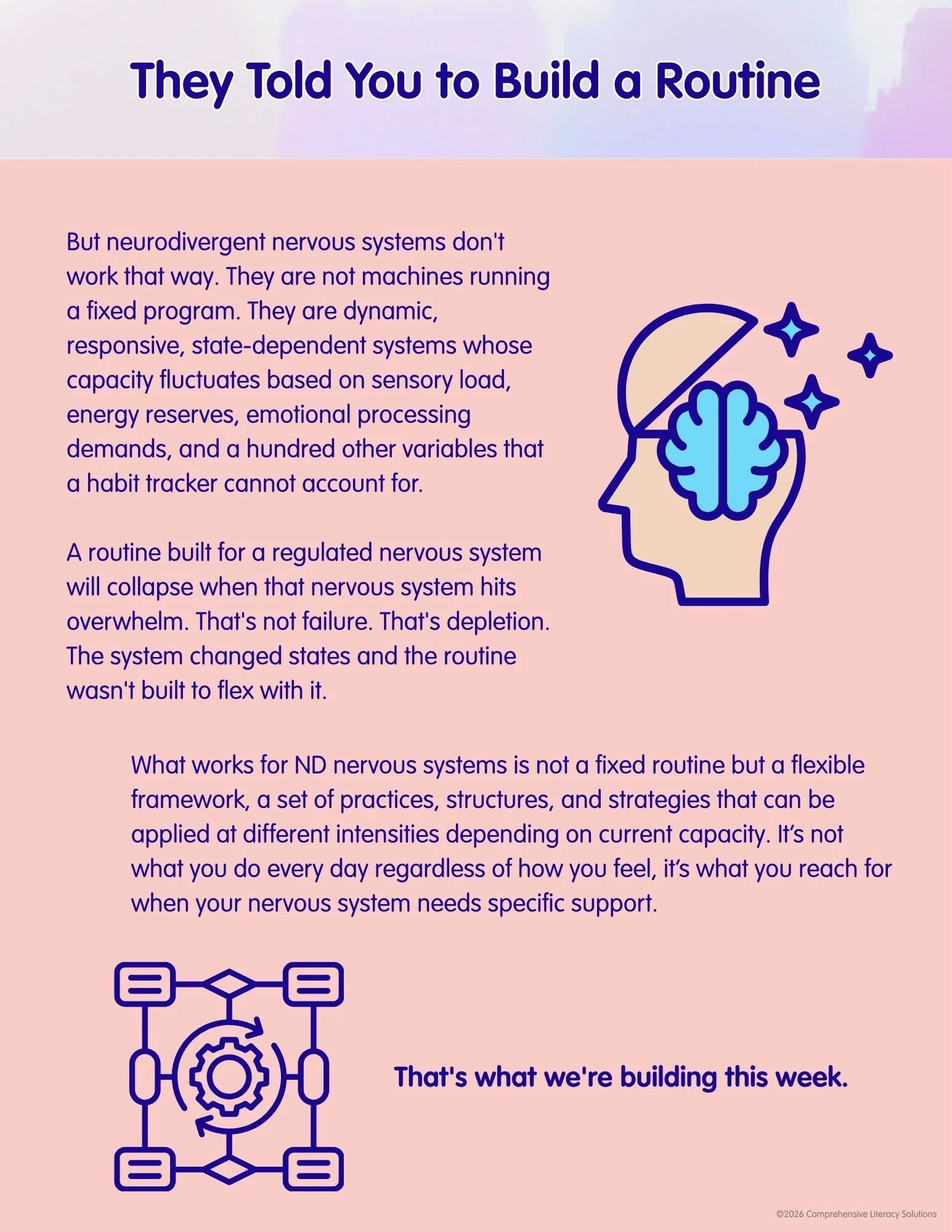
A page from Week 5 of the ND Teacher’s Summer Recovery Series: Decompression in Practice.
This Week Everything Changes
Week 5 marks the turn in this series from understanding into building. The last four weeks gave you something most wellness content never offers: genuine self-knowledge grounded in your own data. This week you use it.
The content pages this week cover two important pieces before the build begins. The first is skill regression, not the dramatic clinical presentation, but the subtle, flexible, everyday version that most ND adults have been misreading as personal failure for years. The second is the ND Burnout Loop. This cycle explains how overwhelm becomes burnout becomes shutdown, and more importantly, how understanding the loop gives you a specific, effective point of intervention.
Both of these are evidence-informed frameworks drawn from the Ali et al. 2025 systematic review of 48 studies on ND burnout recovery. This isn't anecdotal wellness advice. This is what the research says.
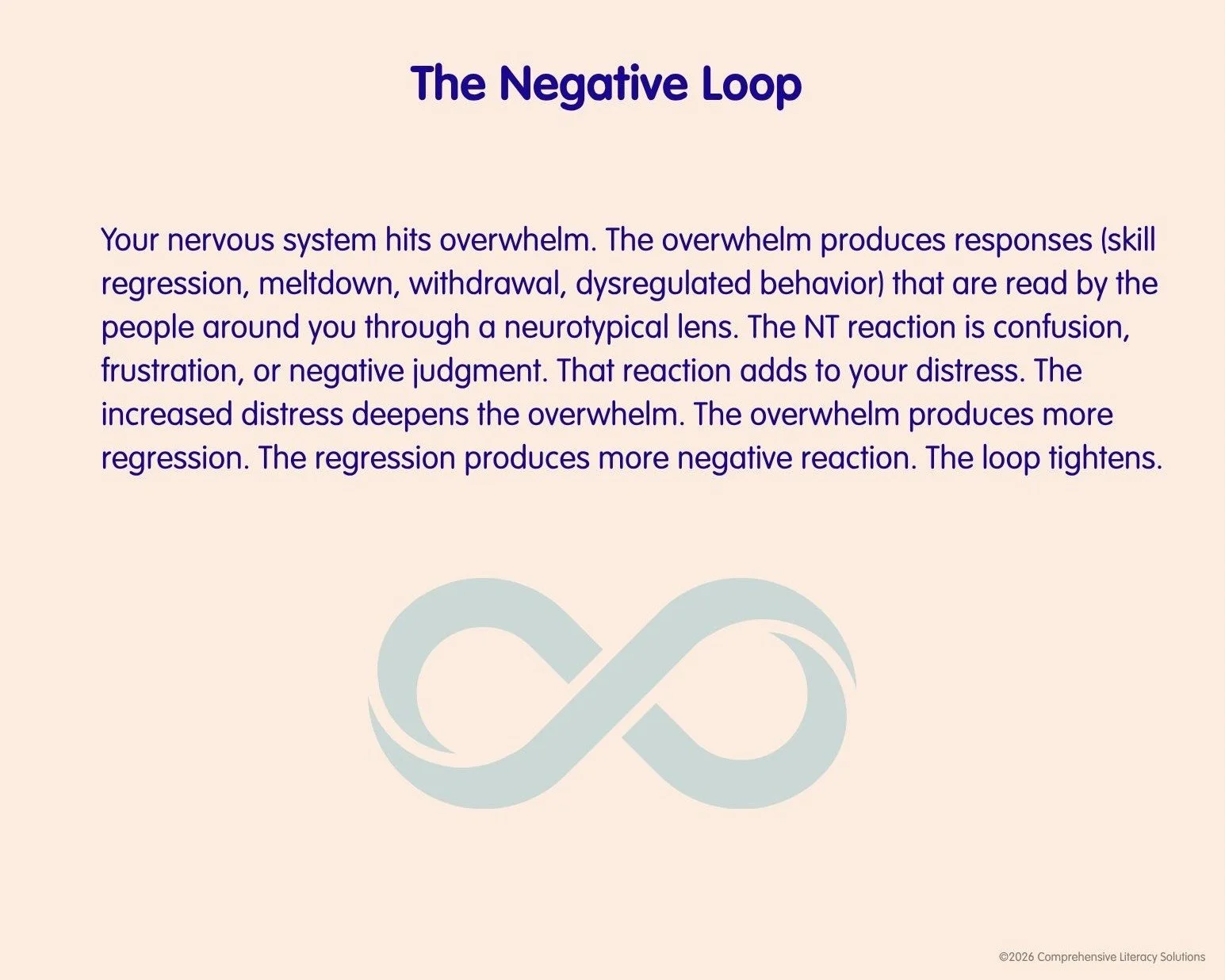
The ND Burnout Loop
What's in This Week's Download
The journal practice this week is a personalized decompression framework constructed entirely from your own data. Your rest inventory, your energy audit, your body signal vocabulary, your continuum placements all become the raw material for something you can actually use when the loop starts to tighten.
Three differentiated template options are provided for different processing styles (structured, semi-structured, and open-ended) along with explicit permission to ignore all of them and build something that looks completely different. Just as differentiated instruction honors the reality that your students process information differently, these templates honor that same reality about you.
Your Week 5 Snapshot Screener gives you your fifth data point. We’re halfway through the summer, and your aimline is becoming visible.
Ready to Build?
Download this week's content below. Complete the screener first. Work through the guiding questions before you choose a template. And give yourself the same grace you'd give a student who needed a different path to the same destination. Remember, we are different, never deficient.
The framework you build this week belongs entirely to you. That's the point.
This PDF is text-to-speech enabled — if you'd prefer to listen rather than read, find accessibility instructions by visiting www.ComprehensiveLiteracySolutions.com/accessibility.
If you'd like a suggested day-by-day path through the Week 1 content, I’ve created a suggested progression as a guide. You can find it by visiting www.ComprehensiveLiteracySolutions.com/guide.