Why "Just Put Them in Intervention" Doesn't Work: The Case for Drilling Down
Why "Just Put Them in Intervention" Doesn't Work: The Case for Drilling Down
A student misses benchmark on the universal screener. You know there’s a problem, but with what? "Below benchmark" tells you almost nothing about what's actually happening inside that reader's brain. Real progress starts with a different question. Not "is this student behind," but "what, specifically, is impacting this student’s progress, and why."
Data Collection Isn't the Goal. Instructional Clarity Is.
Most teachers feel like they’re drowning in data right now. Universal screeners, progress monitoring probes, diagnostic assessments, benchmark composites... it's a lot, and it's easy to feel like the whole point is just to keep collecting more of it.
It isn't. The point of all that data is to answer one question well: what does this specific student need next? That shift, from data collection to what researchers call learning analytics, is the difference between assessment as a compliance exercise and assessment as the engine that actually drives instruction.
This matters even more for neurodivergent learners. A dyslexic student and a student with an attention-related processing difference might both miss the same fluency benchmark for completely different reasons. Give them a misaligned intervention and you'll likely see slow, murky progress with one or both of them. This isn’t because the kids aren't trying. It’s because the instruction was not aligned with their support need.
The Drill-Down Process, In Plain Terms
A well-built assessment structure follows a specific flow. This flow begins broadly and continues to narrow in focus. A universal screener determines if additional screening is needed. If so, diagnostic screeners are administered to determine which foundational skill or skills have not been mastered. Instruction and monitoring follow the student through the tiers of instruction, watching the student’s progress and the intervention’s impact.
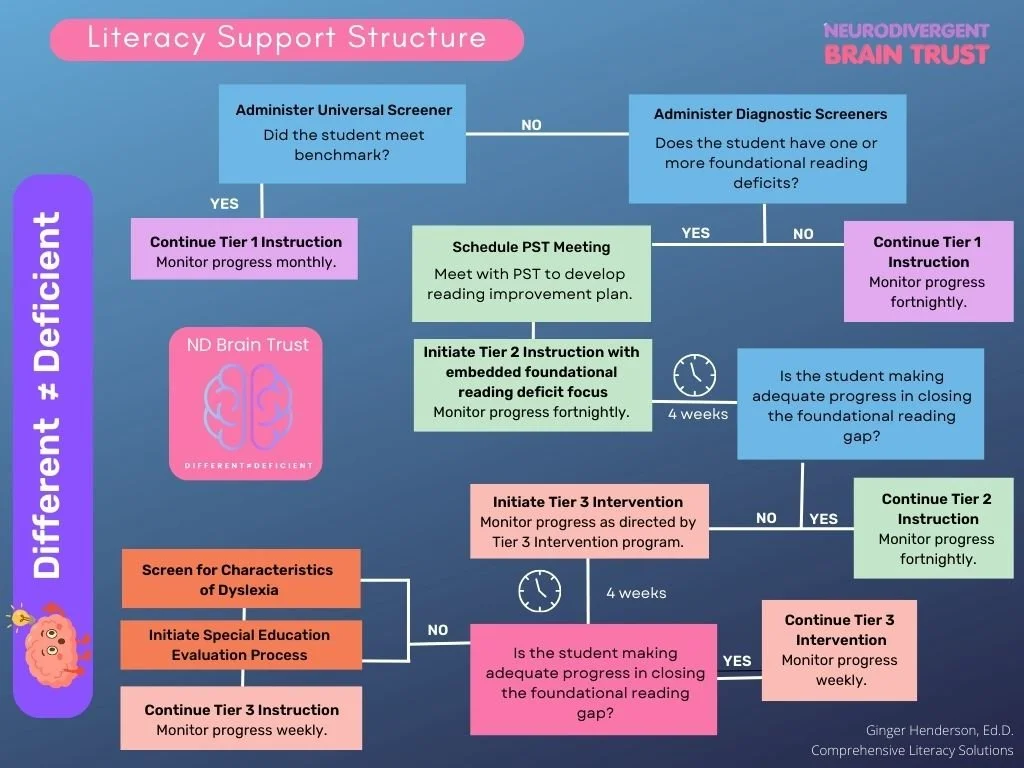
What This Looks Like In Practice
A student's screener shows weak reading comprehension and choppy oral reading fluency. Those are grade-level symptoms. They don't tell you where to intervene.
The drill-down process pushes past that. Is the student accurate when reading aloud? If not, look at word reading fluency. Doesn't hit the cut score? Go a level deeper to psueudoword / nonsense word fluency. Still short? Drop down to letter sound fluency. If needed, keep going to letter naming and phoneme segmentation, which are the baseline foundational skills for literacy.
Wherever the student clears the bar, that's your answer. That's the skill that's solid. The level right above it is where the actual gap lives, and that's where instruction gets targeted. In this example, a student who has mastered letter sounds but stumbles on blending them to read pseudowords has a decoding gap, not a comprehension problem and not a motivation problem. Comprehension instruction alone would never touch that.
This is also where diagnostics earn their keep. A decoding assessment can pinpoint exactly which phonics patterns haven't been mastered. An encoding assessment might reveal a related gap in spelling accuracy, which can point back to an underlying phonemic awareness need. Each layer gets closer to instruction that actually fits.
The Payoff of Doing This Right
When intervention is aimed at the right target, students close gaps faster and teachers see the kind of visible, motivating progress that keeps everyone invested in the process. Research on tightly aligned reading intervention backs this up consistently: specificity speeds growth, and vague, one-size-fits-all support slows it down.
There's also a quieter benefit that matters just as much.
“When a struggling reader finally gets instruction matched to their actual literacy or processing need, the story they’ve internalized about themselves changes.”
It stops being "I'm just bad at reading" and starts being "I needed help with this one specific thing, and now I'm getting it." That reframe is everything for a kid who's spent months or years feeling like something is wrong with them.
The Research Behind This
None of this is a hunch. Researchers Lipson, Chomsky-Higgins, and Kanfer followed schools using this kind of diagnostic, drill-down approach and found that by the middle of the second year, every first grader who had been identified as most struggling met or exceeded the standard on their school's benchmark assessment, and most were released from intervention entirely. That's not a small win. That's kids going from "most at risk" to "no longer needing intervention" because the instruction finally matched the actual gap.
Reading researcher David Kilpatrick has made a similar case for years: intervention only works as fast as it's targeted. Generic support spreads effort across skills a student may already have, while precise diagnosis puts all of that effort where it's actually needed.
“A 2023 study by Strong and Anderson found that students who received targeted intervention closed gaps in missing prerequisite skills after just 18 days of focused summer instruction, further proof that specificity, not just time on task, is what drives growth.”
The takeaway is simple. Drilling down isn't extra work on top of good teaching. It's what makes the teaching work.
Assessment done well isn't about sorting students into who's behind and who isn't. It's about finding, with precision, exactly what a student's brain needs next so instruction can meet them there.
That's not extra work piled on top of good teaching.
That is good teaching.
~Ginger Henderson, Ed.D.
References
On assessment for all learners
Schumm, J. S. (Ed.). (2006). Reading assessment and instruction for all learners. Guilford Press.
On learning analytics
Hershkovitz, A. (2015). Towards data-driven instruction. Technology, Instruction, Cognition, & Learning, 10, 1–4.
Ghodoosi, B., West, T., Li, Q., Torrisi-Steele, G., & Dey, S. (2023). A systematic literature review of data literacy education. Journal of Business & Finance Librarianship, 28(2), 112-127.
Pinto, M., Caballero-Mariscal, D., García-Marco, F.-J., & Gómez-Camarero, C. (2023). A strategic approach to Information Literacy: Data Literacy. A systematic review. El Profesional de La Información, 32(6).
Arnold, J., & Crane, E. W. (2021). Making Decisions: Using Assessment Data in the Time of COVID-19 and Beyond. Region 15 Comprehensive Center.
What is learning analytics. Society for Learning Analytics Research (SoLAR). (2024, August 15).
On neurodivergent learners being at higher risk
Odegard, T. N. (2019). Dyslexia defined: An update with implications for practice. Perspectives on Language and Literacy.
Odegard, T. N., Farris, E. A., Middleton, A. E., Oslund, E., & Rimrodt-Frierson, S. (2020). Characteristics of students identified with dyslexia within the context of state legislation. Journal of Learning Disabilities, 53(5), 366–379.
Cruz, J., Mendes, S. A., Marques, S., Alves, D., & Cadime, I. (2022). Face-to-face versus remote: Effects of an intervention in reading fluency during COVID-19 pandemic. Frontiers in Education, 6.
On the frustration cost of poorly targeted intervention
Pollock, S. (2019). Literacy difficulties: What are learners' experiences? Educational and Child Psychology, 36(1), 101–114.
On treatment integrity and outcomes of tightly aligned intervention
Bianco, S. D. (2010). Improving Student Outcomes: Data-Driven Instruction and Fidelity of Implementation in a Response to Intervention (RTI) Model. Teaching Exceptional Children Plus, 6(5), n5.
Kilpatrick, D. A. (2015). Essentials of assessing, preventing, and overcoming reading difficulties. Wiley.
Lipson, M. Y., Chomsky-Higgins, P., & Kanfer, J. (2011). Diagnosis: The missing ingredient in RTI assessment. The Reading Teacher, 65(3), 204–208.
Lipson, M. Y., & Wixson, K. K. (1986). Reading disability research: An interactionist perspective. Review of Educational Research, 56(1), 111-136.
Strong, J. Z., & Anderson, B. E. (2023). Effects of a summer tutoring program on reading achievement in grades K-5. Reading & Writing Quarterly, 40(5), 456–472.