The ND Teacher’s Summer Recovery Series: Welcome to Week 2 - Listen When Your Body Talks
Someone once told you to try gratitude journaling. Write down three things you're thankful for. Reflect on how they make you feel. Notice the positive emotions and let them anchor you.
So you tried it. You sat with the notebook. You wrote the things. You waited for the feeling.
And either nothing came, or something came but you couldn't quite name it, or you spent twenty minutes trying to figure out whether what you were experiencing was actually gratitude or just the absence of something worse.
Then you closed the notebook and added gratitude journaling to the growing list of wellness practices that apparently work for everyone except you.
Here's what nobody told you: you were never the problem. The assumption underneath the practice was.
What This Week Is About
Gratitude journaling assumes your emotions are easily discernable and nameable. For many neurodivergent brains that assumption simply isn't true. This is not because something is wrong with you, but because your nervous system processes emotional information differently.
Week 2 of the ND Teacher's Summer Recovery Series introduces two ways many neurodivergent people experience emotional awareness, alexithymia and hyperempathy. Many ND people experience one, the other, or both depending on the day, the environment, and how stimulated their nervous system already is.
Neither is a diagnosis. Neither is a flaw. Both are a result of the nervous system’s reaction to the environment.
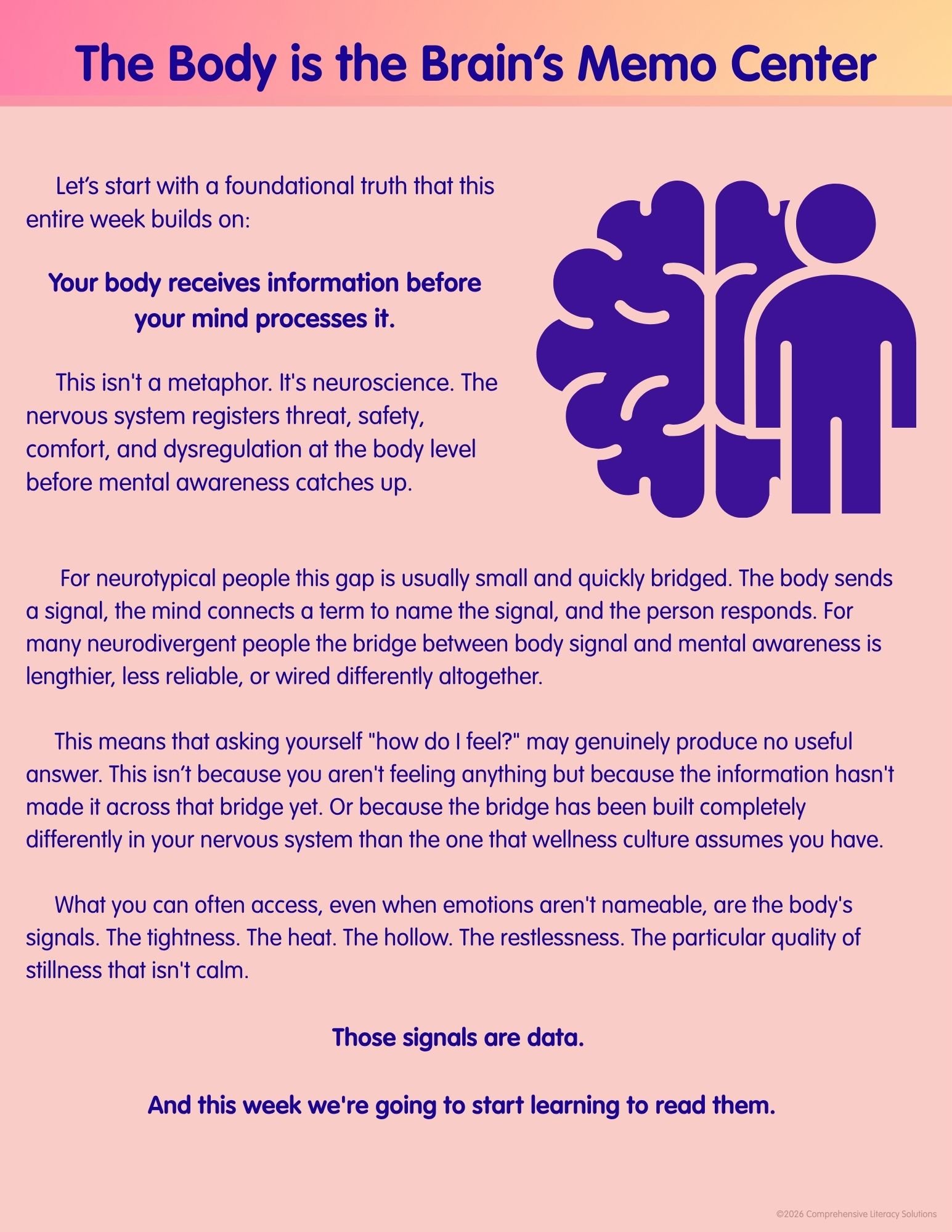
What's in This Week's Download
This week's content pages describe these terms with accessible explanations and links for deeper reading if you want the research.
The download also includes a Body Signal Reference Guide. This chart maps common physical signals to possible nervous system states. When naming an emotion is out of reach, your body is still speaking. This guide helps you start building the vocabulary to hear it.
The journal practice this week begins with a present moment body check-in and moves into a situation-based memory practice inspired by EMDR — a therapeutic approach that has shown particular benefit for people who have experienced the kind of chronic stress many neurodivergent educators carry. This guided practice is not EMDR, and it is not therapy. It is a starting point for learning to listen to the body and notice its signals.
And your Week 2 Snapshot Screener is included so you can add your second data point to the continuum and begin to see your summer taking shape.
Ready to Hear Your Body Talk?
This PDF is text-to-speech enabled — if you'd prefer to listen rather than read, find accessibility instructions by visiting www.ComprehensiveLiteracySolutions.com/accessibility.
If you'd like a suggested day-by-day path through the Week 1 content, I’ve created a suggested progression as a guide. You can find it by visiting www.ComprehensiveLiteracySolutions.com/guide.
Download this week's content below. Read at your own pace. Use the body signal guide as a reference throughout the week. Keep it somewhere accessible and notice what comes up.
Your body has been speaking to you your whole life. This week we start paying attention.