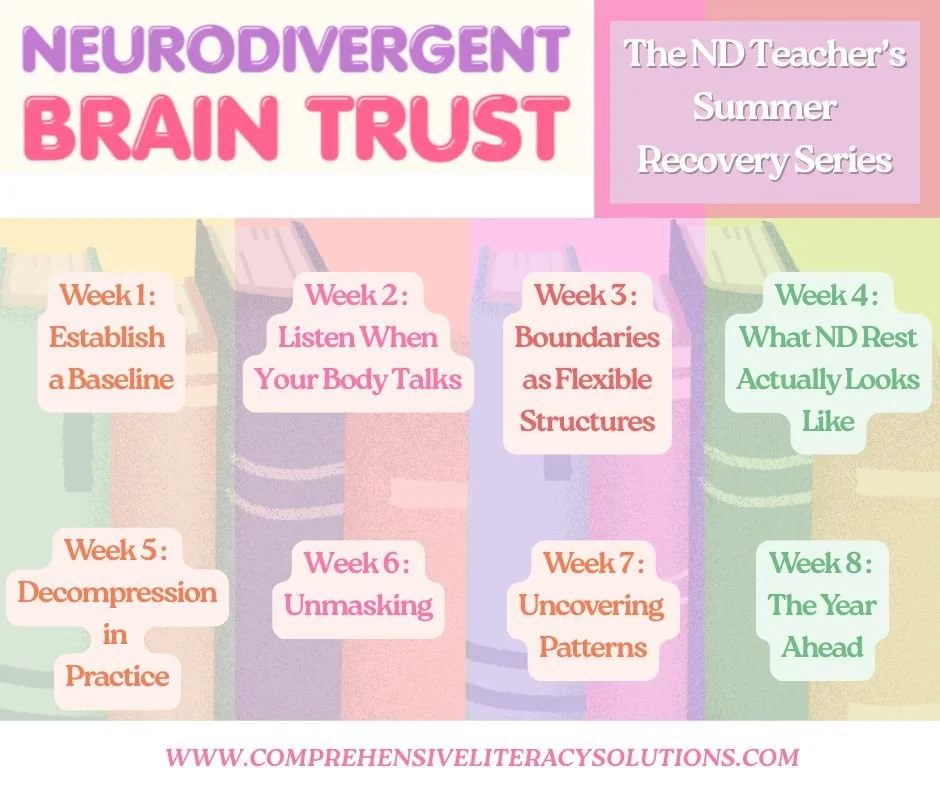
The ND Teacher Summer Recovery Series Guide
Week 1: Establish a Baseline
A Suggested Path Through Week 1
This series is designed to be used in whatever way works best for your brain. There is no wrong way to move through the content. If you're someone who finds structure helpful, or if you're in a place where decision fatigue is real and you'd just like someone to hand you a plan, here's a suggested progression for Week 1:
Day 1 — Download and Begin Reading Download this week's content and begin reading through the continuum section at whatever pace feels comfortable. You don't need to finish today. If text-to-speech works better for you, find accessibility instructions at www.ComprehensiveLiteracySolutions/accessibility.
Day 2 — Finish Reading and Complete the Snapshot Screener Finish reading through the continuum descriptors if you didn't complete them on Day 1. Then turn to the assessment pages and complete the Snapshot Screener. It takes under five minutes. Score it, locate yourself on the continuum, and sit with what you find — no action required yet.
Day 3 — Complete the Full Inventory and Review Your Profile If you'd like a more comprehensive picture, complete the Full Inventory today and score it by domain. Then return to the continuum and reread the descriptor for your overall placement. Read the descriptors for any domains that scored significantly lower than the others. That unevenness is worth understanding before we move forward. The Full Inventory is optional — if the Snapshot Screener gave you what you need, that's enough.
Day 4 — Complete the Nervous System Reset Activity Turn to the journal pages and work through the nervous system reset rounds. You don't need to do anything with what comes up yet. Just complete the rounds, record your brain dumps, and circle your restlessness ratings. Then set it aside.
Day 5 — Reflect and Free Journal Come back to your brain dumps from Day 4 with fresh eyes. Read through what you wrote and notice anything that stands out. Then move to the open journaling pages and write — about the reset experience, about your continuum placement, about what this week surfaced, or about something else entirely that needs space on a page.
This is a suggested structure, not a prescription. If you work better moving through everything in one sitting, do that. If you need more than five days, take them. If you want to skip the Full Inventory entirely, that's a completely valid choice. The only thing this series asks of you is honesty, and you get to decide what that looks like for your brain.
Week 2: Listen When Your Body Talks
A SUGGESTED PATH THROUGH WEEK 2
This series is designed to be engaged with in whatever way works best for your brain. There is no wrong way to move through the content. If you're someone who finds structure helpful or if you're in a place where decision fatigue is real and you'd just like someone to hand you a plan, here's a suggested progression for Week 2:
Day 1 — Read the Content Pages Download this week's content and read through the content pages at whatever pace feels comfortable. You don't need to finish today. As you read, notice whether the descriptions of alexithymia, hyperempathy, or delayed emotional processing resonate with your own experience. You don't need to do anything with that noticing yet.
Day 2 — Spend Time With the Body Signal Reference Guide Read through the Body Signal Reference Guide thoroughly. This isn't a checklist; it's a vocabulary builder. Notice which signals feel familiar. Notice which ones you've experienced without having words for them before. Keep the guide somewhere accessible this week and refer back to it when you notice something physical happening in your body that you can't immediately name.
Day 3 — Complete the Snapshot Screener Complete your Week 2 Snapshot Screener and note your placement on the continuum. Compare it to Week 1 and notice what the data shows. Jot a few quick notes about your notices or questions.
Day 4 — Complete the Present Moment Body Check-In and the EMDR-Inspired Memory Practice Turn to the first journal page and work through the present moment body check-in. Move slowly through each section, noticing what's physically present. There are no wrong observations. If nothing comes up in a particular area, that's information too. Then turn to the second journal page and work through the situation-based memory practice. Choose a moment that feels manageable, not your most difficult memory. After you finish, give yourself some transition time before moving on to other demands. This practice can sometimes bring up things that need a little space to settle.
If anything that comes up during this practice feels bigger than a journaling exercise can hold, please visit the When to Accept Support page before continuing.
www.ComprehensiveLiteracySolutions.com/support
Day 5 — Open Journaling Use the open journaling pages to write about whatever came up this week. You can consider the content, in the body check-in, in the memory practice, or in your daily life as you've been paying attention to your body's signals.
This is a suggested structure, not a prescription. If you work better moving through everything in one sitting, do that. If you need more than five days, take them. If the memory practice doesn't feel accessible this week, skip it and come back when it does. The only thing this series asks of you is honesty, and you get to decide what that looks like for your brain.
Find accessibility instructions at www.ComprehensiveLiteracySolutions/accessibility.
Week 3: Boundaries as Flexible Structures
SUGGESTED PATH THROUGH WEEK 3
This series is designed to be engaged with in whatever way works best for your brain. If structure helps, here's a suggested progression:
Day 1 — Download and Begin Reading the Content Pages Download this week's content and read the content pages at your own pace. Notice which sections land with the most recognition. You don't need to do anything with that yet.
Day 2 — Complete Reading of the Content Pages If you haven’t finished reading the content pages, finish those. Then reflect on the content, and reread any sections that resonated. Write informally if something surfaces, in a notebook, on your phone, or scribbled in the margins of the pages.
Day 3 — Complete the Relationships Energy Audit Turn to the first journal page and work through the relationships audit. Take your time. The variable category (relationships that sometimes deposit and sometimes withdraw) often surfaces the most useful information. Reflect on what you notice before moving on.
Day 4 — Complete the Environment and Sensory Budget Audits Work through the environment and sensory pages. The sensory budget page in particular may take more time than you expect, as you may have never mapped your sensory triggers explicitly before. Let it be slow. The proactive planning question at the bottom of the sensory page is worth returning to more than once.
Day 5 — Free Journal and Reflect on the Full Audit Read back over all three audit pages.Reflect on the closing questions. Let your free journaling respond to whatever the audit surfaced.
This is a suggested structure, not a prescription. The audit pages can be completed in one sitting if that works better for your brain. If the fawn or PDA sections surface something that feels bigger than a journaling exercise can hold, please visit the When to Accept Support page before continuing.
www.ComprehensiveLiteracySolutions.com/support.
Find accessibility instructions at www.ComprehensiveLiteracySolutions/accessibility.
Week 4: What ND Rest Actually Looks Like
SUGGESTED PATH THROUGH WEEK 4
If structure helps, here's a suggested progression:
Day 1 — Download and Begin Reading the Content Pages Download this week's content and read the content pages at your own pace. Notice which sections land with the most recognition. You don't need to do anything with that yet.
Day 2 — Complete Reading of the Content Pages If you haven’t finished reading the content pages, finish those. Then reflect on the content, and reread any sections that resonated. Make notes about your reflections and why those sections resonated.
Day 3 — Complete the Sensory and Creative Rest Inventory Sections Work through the first two inventory sections slowly. For activities you haven't engaged with recently, rate based on memory or mark them as unknown and return to them later. The open-ended questions at the bottom of each section are worth taking some extra time to consider. They often surface more useful information than the ratings themselves.
Day 4 — Complete the Social Rest and Movement Inventory Sections Work through the remaining inventory sections. The social rest section in particular may bring up complexity. Give yourself the time needed to work through this unrushed.
Day 5 — Complete the Inventory Reflection and Free Journal Read back over all five inventory sections and answer the reflection questions at the end. Then free journal about whatever the inventory surfaced. Keep the completed inventory somewhere accessible. You'll bring it directly into Week 5.
This is a suggested structure — not a prescription. The inventory can be completed in one sitting if that works better for your brain. If anything in this week's content surfaces a recognition of depletion that feels heavier than expected, please visit the When to Accept Support page.
www.ComprehensiveLiteracySolutions.com/support
Find accessibility instructions at www.ComprehensiveLiteracySolutions/accessibility.
Week 5: Decompression in Practice
SUGGESTED PATH THROUGH WEEK 5
If structure helps, here's a suggested progression:
Day 1 — Read the Content Pages Download and read the content pages. The skill regression section in particular may need some time to sit with. If recognition comes up, you may want to give it some space before moving on.
Day 2 — Sit With the Skill Regression Section and Complete the Snapshot Screener Return to the skill regression content specifically. Consider what your personal version looks like. Write informally about it if something surfaces. Making some jot notes in the margins could be helpful here. Then complete the Snapshot Screener and plot your data point.
Day 3 — Work Through the Guiding Questions Turn to the journal pages and work through the guiding questions before looking at the templates. These questions are designed to surface your framework content before you try to organize it. Take your time — some questions will connect directly to earlier weeks and may benefit from flipping back to review your previous journal entries and screener data.
Day 4 — Choose Your Template and Build Review the three template options and choose the one that fits your brain, or combine elements, or build something entirely different. Use your guiding question responses as the source material. This is the most important journal page in the series so far. Give it the time it deserves.
Day 5 — Free Journal and Review Write freely about the framework build: what felt clear, what felt difficult, what surprised you. Then read back over your completed framework and notice how it feels to see your own self-knowledge organized into something usable. Keep this page somewhere accessible. You'll return to it in Week 8.
This is a suggested structure — not a prescription. If you work better moving through everything in one sitting, do that. If the skill regression section surfaces something that feels heavier than a journaling exercise can hold, please visit the When to Accept Support page before continuing. www.CompreheniveLiteracySolutions.com/support.